

Why Bourbon and Cigars Belong Together: A Reader's Guide to the Pairing Wheel
A great cigar and a great bourbon don't just coexist on the table. They argue with each other. They finish each other's sentences. Sometimes they disagree, and that's the point.
For most of the last two centuries, the pairing of bourbon and cigars has been treated as a matter of personal taste — something you figure out by trial and error, or by following the recommendations of whoever happened to be standing next to you at the lounge. There's nothing wrong with that, but it leaves a lot on the table. The pairing of bourbon and cigars isn't random. It follows patterns that flavor scientists have been mapping for decades, and once you understand those patterns, you can stop guessing.
This is the logic behind the Bourbon & Cigar Pairing Wheel, the centerpiece of Smoke & Oak: The Shared Legacy of Bourbon and Cigars. The wheel is a visual guide that maps the flavor families of bourbon on one side and the flavor families of cigars on the other, with three different kinds of pairing relationships connecting them. Here is how it works.
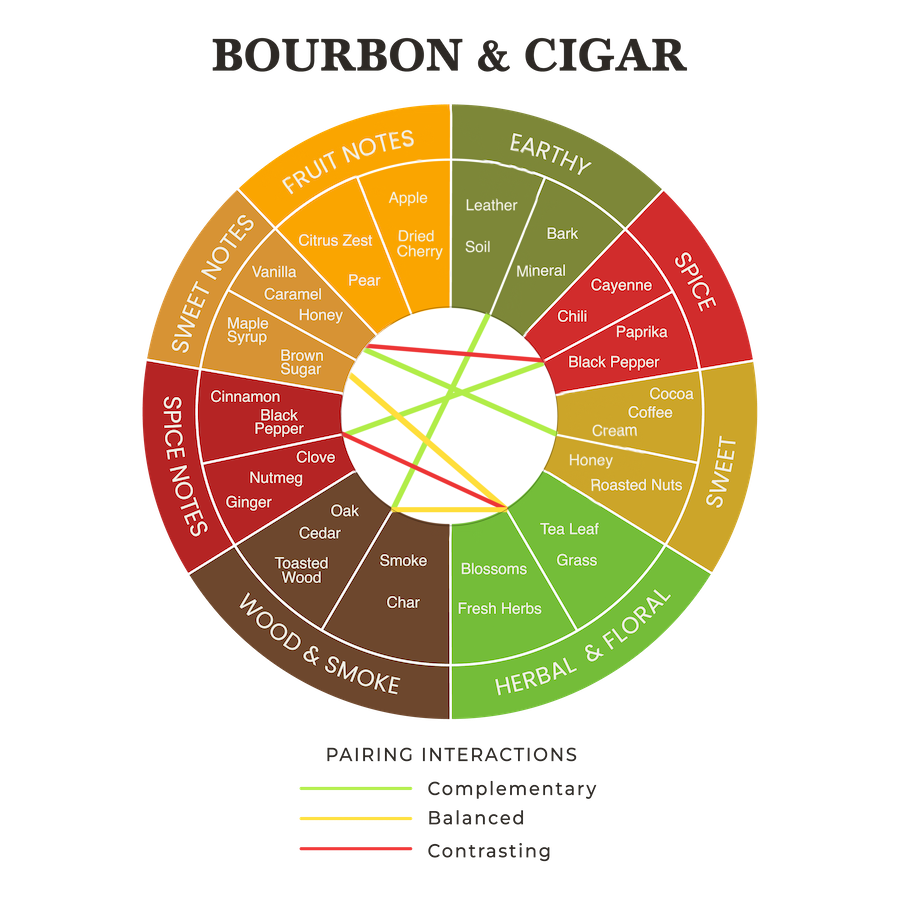
The Bourbon & Cigar Pairing Wheel — bourbon flavor families on the left, cigar flavor families on the right, with three kinds of pairing relationships connecting them. The full color version, along with detailed pairings for thirty American distilleries, appears in Smoke & Oak.
The Four Flavor Families of Bourbon
Bourbon doesn't taste like one thing. Even within a single distillery's lineup, you'll find dramatically different flavor profiles depending on the mash bill, the barrel char, the proof, and the age. But bourbon's flavors tend to cluster around four broad families.
Sweet Notes — vanilla, caramel, honey, maple syrup, brown sugar. These come primarily from the new charred oak barrel during aging. The deeper the char, the more these emerge.
Fruit Notes — apple, pear, citrus zest, dried cherry. These come from the corn and rye in the mash bill and from longer aging, which develops deeper fruit complexity.
Spice Notes — cinnamon, black pepper, clove, nutmeg, ginger. High-rye bourbons like Bulleit and Old Grand-Dad push hard into this territory. Wheated bourbons like Maker's Mark and Pappy Van Winkle lean away from it.
Wood & Smoke — oak, cedar, toasted wood, occasionally a whisper of smoke. Older bourbons concentrate these notes; the wood eventually starts to dominate if a bourbon is aged too long.
Most bourbons live in two or three of these families at once. Buffalo Trace pulls from Sweet Notes, Fruit Notes, and a touch of Wood & Smoke, with relatively little Spice. Wild Turkey 101 pulls from Sweet Notes and Wood & Smoke with significant Spice. Knowing where a bourbon sits is the first step to knowing what to smoke with it.
The Four Flavor Families of Cigars
Cigars work the same way, but their flavor families come from different sources: the leaf, the curing, the fermentation, and the wrapper.
Earthy — leather, soil, bark, mineral. These flavors are most pronounced in well-fermented Nicaraguan and Honduran tobaccos, particularly in fillers from Estelí or Jalapa.
Spice — cayenne, chili, paprika, black pepper. Ligero leaves from the top of the tobacco plant carry the most spice. Pepper-forward cigars tend to feature a higher proportion of ligero in the blend.
Sweet — cocoa, coffee, cream, honey, roasted nuts. These come from extended fermentation, particularly in maduro wrappers. The longer the fermentation, the sweeter the cigar tends to read on the palate.
Herbal & Floral — tea leaf, grass, blossoms, fresh herbs. Connecticut Shade wrappers and Cameroon tobaccos lean into this territory, as do many Dominican puros.
A great cigar, like a great bourbon, lives in two or three flavor families at once. A maduro-wrapped Nicaraguan cigar might pull from Sweet, Earthy, and Spice. A Connecticut-wrapped Dominican might pull from Sweet, Herbal & Floral, and a touch of Earthy.
The Three Kinds of Pairing
Now the interesting part. Once you know where your bourbon sits and where your cigar sits, you can decide what kind of pairing you want to create. There are three.
Complementary pairings match similar flavor families across both sides of the wheel. A bourbon heavy in Sweet Notes (vanilla, caramel) pairs beautifully with a cigar heavy in Sweet (cocoa, coffee). The flavors reinforce each other, deepening the overall experience. Think of it as two voices singing the same melody an octave apart.
Balanced pairings match adjacent flavor families. A bourbon with strong Spice Notes (cinnamon, black pepper) pairs well with a cigar in the Earthy family (leather, soil) — they don't echo each other directly, but they share enough territory to feel coherent. Balanced pairings are the safest and most common choice, and they're a good place to start if you're new to pairing intentionally.
Contrasting pairings match opposite flavor families across the wheel. A wheated bourbon heavy in Sweet Notes paired with a peppery, ligero-heavy cigar creates deliberate tension — the sweetness of the bourbon softens the spice of the cigar, while the spice cuts through the sweetness. This is the most adventurous category and the hardest to get right, but when it works, contrasting pairings create the most memorable experiences.
A Worked Example
Let me show you how this works with a specific pairing.
Say you've got a glass of Buffalo Trace. We know it sits primarily in Sweet Notes (vanilla, toffee), Fruit Notes (apple, dried cherry), and a touch of Wood & Smoke (oak).
A complementary pairing would be a maduro-wrapped cigar with strong Sweet notes — something like a Padrón 2000 Maduro, with its rich cocoa and coffee. The bourbon's vanilla and the cigar's cocoa reinforce each other across the wheel. Both sides are speaking the same language.
A balanced pairing would be a Nicaraguan cigar with prominent Earthy notes — something like an Oliva Serie V Melanio. The bourbon's sweet and fruit notes find a stable counterpart in the cigar's earthiness. Neither side dominates; they hold each other up.
A contrasting pairing would be a peppery, ligero-heavy cigar — something like a My Father Le Bijou 1922. The cigar's spice and the bourbon's sweetness meet across the wheel and create deliberate friction. It's a bigger experience, but it requires a bourbon that can hold its own against the cigar's intensity.
None of these pairings is wrong. They're three different conversations, each suited to different moods, different occasions, different palates.
Why This Matters
Pairing isn't a science in the strict sense. There's no equation that tells you a Maker's Mark plus an Arturo Fuente Hemingway equals a 9.4 out of 10. What pairing offers is a framework for noticing — a way to slow down and pay attention to what's happening on the palate, what's happening in the room, what's happening between two things that were each crafted to be experienced alone but become something more when experienced together.
The Bourbon & Cigar Pairing Wheel is a tool for that noticing. It doesn't replace your taste; it sharpens it. It gives you language for what you're already feeling and a starting point for experiments you might not have considered.
The full color wheel, along with detailed pairing recommendations for thirty prominent American distilleries, lives in Smoke & Oak: The Shared Legacy of Bourbon and Cigars. The book also includes the molecular science behind why these pairings work, the regional terroir that shapes flavor profiles, and a complete glossary of bourbon and cigar tasting terminology.
Pour something good. Light something good. See what happens between them.